
Journeys
Thailand in Three Speeds: Is This a Better Way to See It for the First Time?
Bangkok at full tilt. Northern Thailand at elephant pace. Then seven nights beside the Andaman Sea. A city–jungle–beach journey sounds like the perfect first taste of Thailand — but how much should you really try to squeeze into thirteen nights, and what does travelling in May change?
There is a particular temptation when planning Thailand for the first time: having flown halfway around the world, you feel obliged to see all of it.
Bangkok. Chiang Mai. Temples. Elephants. Phuket. Phi Phi. Krabi. Another island because somebody on Instagram went there. Perhaps squeeze in Ayutthaya while we’re at it.
Before long, your holiday has become an unusually expensive method of transporting a suitcase around Southeast Asia.
There is another way.
Spend a few days somewhere exhilarating. Slow down. Change landscape. Change pace. Then — and this may be the cleverest part — stop moving altogether.
We started looking at one particular 13-night itinerary because of its simple structure: three nights in Bangkok, a night at an elephant camp in northern Thailand, two nights in Chiang Mai and seven nights in Phuket.
On paper, that’s city, jungle and beach.
Look a little closer and it becomes something more interesting.
It’s Thailand in three speeds.
First speed: Bangkok
Three nights in Bangkok sounds short until you consider the alternative.
Bangkok is enormous, hot, frequently congested and gloriously uninterested in making itself convenient for a first-time visitor. Trying to “do” it in three days is impossible.
So don’t.
Three nights works surprisingly well if you accept that you’re getting an introduction rather than completing Bangkok.
The historic city deserves time: the Grand Palace and Wat Phra Kaew, Wat Pho and Wat Arun are obvious names for good reason. But so does the Chao Phraya River. So does Chinatown. So does modern Bangkok, which can feel like another city entirely.
The trick is editing.
Pick the things that matter to you rather than constructing a military operation involving six temples, three markets, a shopping centre and a rooftop bar before dinner.
Bangkok traffic makes geography matter too. The BTS Skytrain, MRT and river services can sometimes be far more useful than spending part of your first holiday in Thailand examining the upholstery of a stationary taxi.
The hotel on the itinerary that prompted this article, Century Park, illustrates the trade-off rather neatly. It’s a solid four-star hotel in the Pratunam–Victory Monument area, with generally strong traveller feedback for cleanliness, rooms and value and public transport within walking distance.
What it isn’t is a hotel whose front door immediately deposits you into Bangkok’s most atmospheric streets.
That needn’t be a problem for three nights. Ride-hailing apps can make getting around relatively straightforward, and being slightly removed from the busiest tourist areas has advantages after a day in central Bangkok. But we’d choose Century Park because it does the job well, not because the hotel itself is the reason to visit Bangkok.
ELENEL TIP
If you’re visiting the Grand Palace, don’t improvise the wardrobe. It is a place of reverence and has a strict dress code: sleeveless tops, short trousers and various other types of inappropriate clothing aren’t permitted. Dress properly before leaving the hotel rather than discovering this at the entrance in serious Bangkok heat.
And that heat matters.
A May visit to Bangkok is not necessarily the gentle introduction suggested by glossy photographs. Expect heat and humidity, with showers and thunderstorms possible. Build breathing space into the day.
The midday sun is not an opponent you need to defeat.
Second speed: North
Then the journey changes.
This is why we wouldn’t be tempted simply to replace Chiang Mai with another few days on the beach.
Northern Thailand adds something Bangkok cannot.
Chiang Mai carries the legacy of the old Lanna kingdom and has its own architecture, food traditions and rhythm. Its historic centre is manageable in a way Bangkok emphatically isn’t, while mountains and rural country sit beyond the city.
But this particular itinerary does something else before reaching Chiang Mai.
It disappears into the countryside.
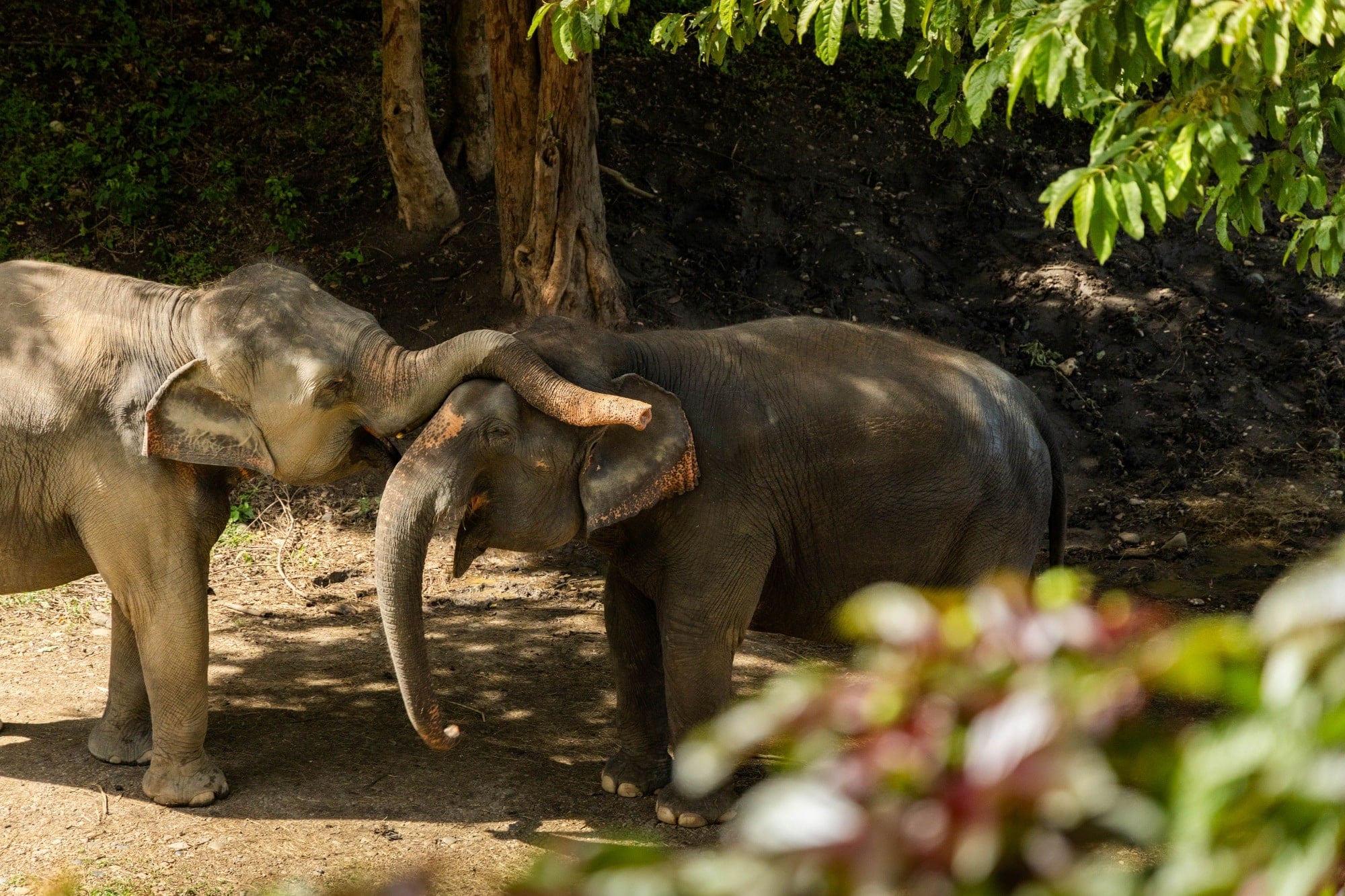
One night with elephants. Is that really enough?
The Bush Camp Chiang Mai sits beside the Ping River, around two hours by road from Chiang Mai. Despite the name, the accommodation isn’t an exercise in hardship: these are substantial safari tents with proper beds, bathrooms and air-conditioning.
More importantly, a one-night stay is really a two-day experience.
The camp’s published programme includes the transfer from Chiang Mai, meals, time learning about the elephants and their mahouts, food preparation, observation and cultural activities before returning to Chiang Mai the following day.
Traveller feedback repeatedly praises the setting, food, guides, accommodation and the feeling that the experience isn’t rushed. There is also a recurring sentiment worth noticing: plenty of people who choose the one-night programme come away feeling they could happily have stayed longer.
Our view?
One night works. Two would probably be better.
One night isn’t a token afternoon elephant excursion. There is enough across the two days to justify the journey. But another night would allow the camp itself to become part of the experience rather than somewhere you have only just unpacked before thinking about leaving again.
And there is a much more important question than how many nights you stay.
Before you book an elephant experience, ask what the elephant gets out of it
Thailand’s relationship with elephant tourism is complicated.
For years, experiences were marketed around what humans could do with elephants: ride them, wash them, feed them, touch them, pose beside them.
Then “ethical” and “sanctuary” became the words travellers learnt to look for.
Unfortunately, a reassuring word on a sign isn’t an animal-welfare policy.
ABTA’s current guidance classifies activities including elephant riding and bathing as unacceptable. Its guidelines also identify tourist contact or feeding elephants without a barrier as unacceptable and encourage a move towards observing elephants from a respectful distance.
World Animal Protection goes further still, advising travellers to favour observation-led venues where elephants have space, choice and the opportunity to behave naturally rather than being required to interact with visitors.
There is a useful principle here:
The less an elephant is required to entertain you, the better.
That means being suspicious of experiences built around touching, tricks, bathing, riding or creating the perfect photograph.
Ask different questions.
Can the elephants move away?
Are they being made to perform?
Is the experience built around their behaviour, or ours?
Would it still be worth visiting if you never touched an elephant at all?
The Bush Camp is particularly interesting because its approach has recently changed.
From 1 May 2026, it stopped allowing guests to hand-feed its elephants. Food is instead placed at designated feeding stations, with the camp saying elephants can eat at their own pace and that the experience is moving away from direct contact towards observation.
That is a meaningful change.
It also demonstrates why travellers need to look beyond old reviews. A review describing exactly what somebody did with an elephant two years ago may no longer describe the experience being offered today.
Responsible wildlife tourism is evolving.
That’s a good thing.
Chiang Mai deserves longer than you’re giving it
After The Bush Camp, this itinerary gives Chiang Mai another two nights.
Here we reach its first genuine weakness.
Two nights is enough to enjoy Chiang Mai.
It isn’t enough to understand it particularly well.
The Dusit Princess Chiang Mai helps because its location on Chang Klan Road puts the Night Bazaar almost on the doorstep and the Old City within easy reach. The hotel underwent a comprehensive three-year transformation before reopening in December 2024.
Recent traveller feedback is particularly strong on location and cleanliness, although comments about soundproofing, smaller bathrooms and occasional room noise crop up too.
Again, this is a hotel we’d choose largely because where it puts you is useful.
The danger is trying to compensate for having only two nights by doing too much.
Chiang Mai can quickly produce another checklist: Old City temples, the Night Bazaar, Wat Phra That Doi Suthep, markets, food, cooking classes and countryside excursions.
Something has to give.
If we were designing the journey purely around seeing northern Thailand properly, we’d add time here. Probably another night at The Bush Camp or another night in Chiang Mai — ideally both.
But that creates another problem.
Those nights have to come from somewhere.
And that brings us to Phuket.
Third speed: Stop
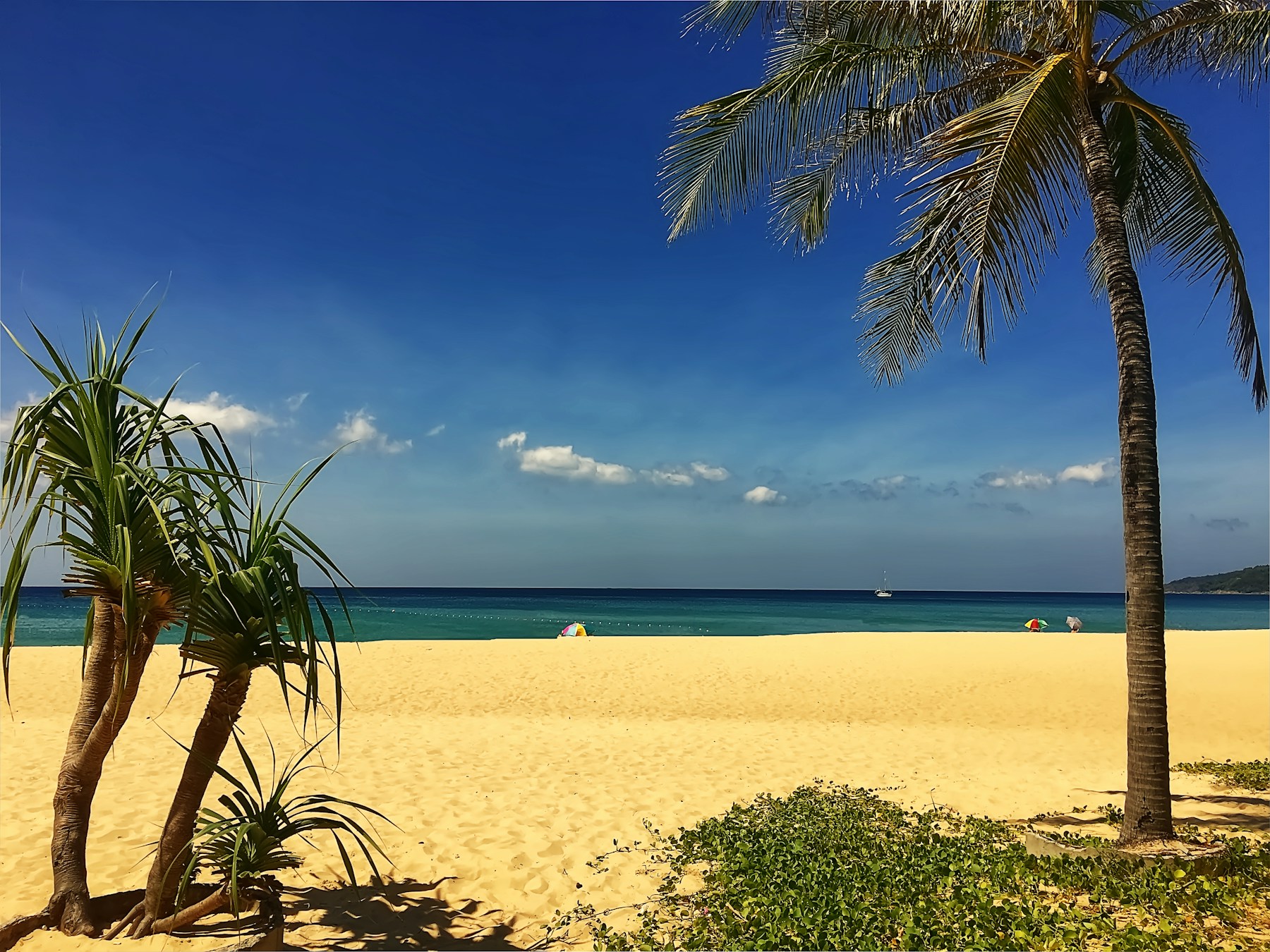
Seven nights in Phuket initially looks indulgent after six nights of travelling.
We think that’s precisely why it works.
By now you’ve crossed Thailand, changed hotels several times, travelled into the countryside and back, experienced two cities and probably developed a close personal relationship with your luggage.
Then, for a week, nobody asks you to pack it.
There is a tendency to regard a multi-centre holiday as better value if it contains more centres.
It isn’t.
Sometimes the most intelligent thing an itinerary can do is stop.
Seven nights gives you permission to have a day on which nothing culturally significant happens.
Read. Swim. Have lunch. Discover that you’ve accidentally spent 40 minutes discussing where to have dinner.
This is still a holiday.
Why Karon rather than Patong?
Phuket isn’t one experience.
Patong is the island’s best-known resort centre and the obvious choice for people who want nightlife, crowds and plenty happening within walking distance.
Karon is a different proposition.
Its long beach and resort town still provide restaurants, bars, shops and the normal machinery of a Thai beach holiday, but traveller feedback repeatedly describes it as less intense and less commercial than Patong.
Don’t confuse that with undiscovered Thailand.
Karon is a developed resort. If your idea of paradise is a tiny beach with three fishing boats and nobody selling anything, this isn’t it.
But after Bangkok and northern Thailand, Karon’s middle ground makes sense: enough infrastructure to be easy, enough distance from Patong to turn the volume down.
Centara Karon Resort Phuket follows much the same philosophy.
Following an extensive renovation, it is a substantial resort with distinct accommodation areas and three swimming pools across a large pool complex. Karon Beach is only a short walk away.
It is particularly well equipped for families — something couples should understand before booking it.
Recent guests regularly praise its location, staff and facilities, while some also mention noise around the more family-focused areas.
That’s the trade-off.
This is an active, well-equipped resort rather than an intimate romantic hideaway where the loudest event of the afternoon is somebody opening a book.
For a week of decompression after touring, though, its practical strengths are obvious.
There is just one rather large complication.
We need to talk about May
The itinerary that inspired this article departs on 10 May.
If seven days of reliably dry beach weather is the single most important part of your holiday, we would think carefully before choosing Phuket in May.
That does not mean May is a bad time to go.
Travelling outside the peak dry-season period can bring attractive value, fewer peak-season crowds and perfectly good spells of sunshine.
But it also brings greater uncertainty.
By May, the southwest monsoon is increasingly influencing Thailand’s Andaman coast. Rainfall becomes less predictable and sea conditions can become rougher.
Historical weather illustrates why that distinction matters.
During May 2026, the Thai Meteorological Department issued several warnings as the southwest monsoon strengthened. On 17 May, for example, it reported heavy to very heavy rain in parts of Thailand and forecast waves of 2–3 metres from Phuket northwards, rising above three metres in thunderstorms. Further strong-wind and heavy-rain warnings followed later that month.
That is not a forecast for May 2027.
It is evidence of what can happen in Phuket at that time of year.
There may be long spells of sunshine. There may be brief tropical downpours. There may be days when the sea is far rougher than the brochure photograph suggests.
The sensible response isn’t to write off May.
It is to understand the trade-off before you book it.
Pay attention to beach flags and local advice. Rough water and rip currents deserve considerably more respect than an itinerary.
ELENEL TIP
On a May Phuket holiday, don’t schedule every important excursion before you’ve even left Britain. Keep some flexibility. If the forecast gives you a particularly good day for the sea, use it. Museums, spas, restaurants and Phuket Old Town are rather less offended by rain.
There is an upside to seven Phuket nights here too.
A three-night beach stay can be badly compromised by two wet days.
Over seven nights, you’ve given the weather more chances to behave itself.
So, is this the right way to see Thailand for the first time?
Not the right way.
There isn’t one.
Someone fascinated by northern Thailand should steal nights from Phuket and give them to Chiang Mai. Someone whose idea of Thailand is primarily islands and diving may want less Bangkok. Someone who values reliable beach weather above almost everything else might choose a different month.
But there is something unusually sensible about the shape of this journey.
It doesn’t confuse seeing more places with having a better holiday.
Bangkok gets enough time to overwhelm you without exhausting you.
Northern Thailand changes the landscape and introduces a completely different rhythm.
The Bush Camp creates a deliberate pause and, importantly, offers an elephant experience moving in the right direction: away from performance and towards observation.
Chiang Mai is the section we’d most like to lengthen.
And then Phuket does something that looks almost lazy on an itinerary and feels rather clever once you’re actually travelling:
it gives you a week in which you don’t have to go anywhere.
Perhaps that is the lesson for a first trip to Thailand.
Don’t try to finish the country. You won’t.
Give yourself enough contrast to understand how varied it is — and enough time in each place to notice where you actually are.
Then stop moving. Thailand will still be there when you come back.
Fancy doing it?
The itinerary that inspired this story is currently available through Elenel Getaways for 13 nights departing 10 May 2027, combining Bangkok, The Bush Camp and Chiang Mai with seven nights at Centara Karon Resort Phuket.
Current prices start from £2,099pp from Manchester with indirect flights, with other departure airports available. Deposit from £99pp.
We’d choose it with our eyes open: May can offer excellent value, but Phuket’s weather and sea conditions are less predictable than during the dry season, and travellers particularly interested in northern Thailand may want us to look at extending that part of the journey.
Elenel Getaways can check the latest availability and tailor the journey if you’d prefer a different balance between city, north and beach.
Holiday operated by Gold Medal Travel Group. ATOL 2916 / ABTA V6805. Prices are subject to availability and change.