
Cruise & River
Forget the Rhine for a Minute. What Happens When You River-Cruise Colombia?
River cruising usually conjures up cathedral spires, vineyard slopes and a polite sequence of European capitals. Colombia’s Magdalena offers something rather different: colonial towns, river communities, cumbia, birdlife and a country whose history has always flowed towards the Caribbean. But does seeing Colombia from a small ship bring you closer to it — or keep you comfortably at arm’s length?

Say “river cruise” to a British traveller and there is a reasonable chance their mind will drift towards the Rhine.
Perhaps the Danube.
There will be a castle. Almost certainly a church tower. Somebody will eventually discuss wine.
Colombia is probably not the next thing that springs to mind.
Which is precisely why the Magdalena River caught our attention.
AmaWaterways currently operates seven-night journeys along the Magdalena between Cartagena and Barranquilla, using two unusually small ships: AmaMagdalena carries 60 passengers and AmaMelodia 64. The route includes Mompox and smaller communities along a river that has spent centuries functioning as one of Colombia’s great arteries.
That raises a far more interesting question than whether the cabins have balconies.
What happens when you take a style of travel most associated with Europe and drop it into Colombia?
And perhaps more importantly: is a river cruise actually a good way to understand the country?
First, the river matters
The Magdalena is not some convenient piece of water around which a cruise company has designed an itinerary.
It is fundamental to Colombia.
The river runs north through much of the country before reaching the Caribbean at Barranquilla. For centuries it linked the interior with the coast, carrying people, goods, ideas and, inevitably, power.
It also runs through Colombia’s cultural imagination.
Gabriel García Márquez knew it personally. As a young man he travelled along the river between Colombia’s Caribbean region and the interior, and the Magdalena later became entwined with the landscapes and atmosphere of his writing.
That changes the premise.
You are not simply cruising through Colombia.
You are following one of the routes along which Colombia developed.
And that is much more interesting.
Cartagena is almost too easy to love
The journey begins, or ends depending on direction, in Cartagena.
This is the Colombia most international visitors already know.
Inside the old walls are balconies, churches, plazas and colonial buildings preserved well enough for Cartagena’s historic centre and fortifications to hold UNESCO World Heritage status.
It is enormously photogenic.
Possibly suspiciously photogenic.
There is a danger with Cartagena that the city becomes reduced to pastel walls, bougainvillea and whichever doorway currently has a queue forming for Instagram.
Its history is considerably less decorative.
Cartagena was one of the Spanish empire’s most important Caribbean ports, a place through which wealth, military power and enslaved people moved.
The walls that look handsome at sunset were defensive infrastructure in a violent imperial system.
That does not make Cartagena less compelling.
It makes it more so.
The best first encounter should therefore include both versions: the beautiful Caribbean city and the history underneath it.
And then, rather usefully, the river takes you somewhere less obvious.
Mompox might be the reason this journey works
If there is one place that makes the case for travelling Colombia this way, it may be Santa Cruz de Mompox.
Even the name feels as though it ought to arrive accompanied by a novel.
Mompox was founded on the Magdalena in the 16th century and became an important commercial and strategic point on the route between Cartagena and inland Colombia.
Then its fortunes changed.
River traffic shifted. The town lost much of its importance.
Usually that would be the bad news.
For travellers nearly two centuries later, it is partly why Mompox survives as it does.
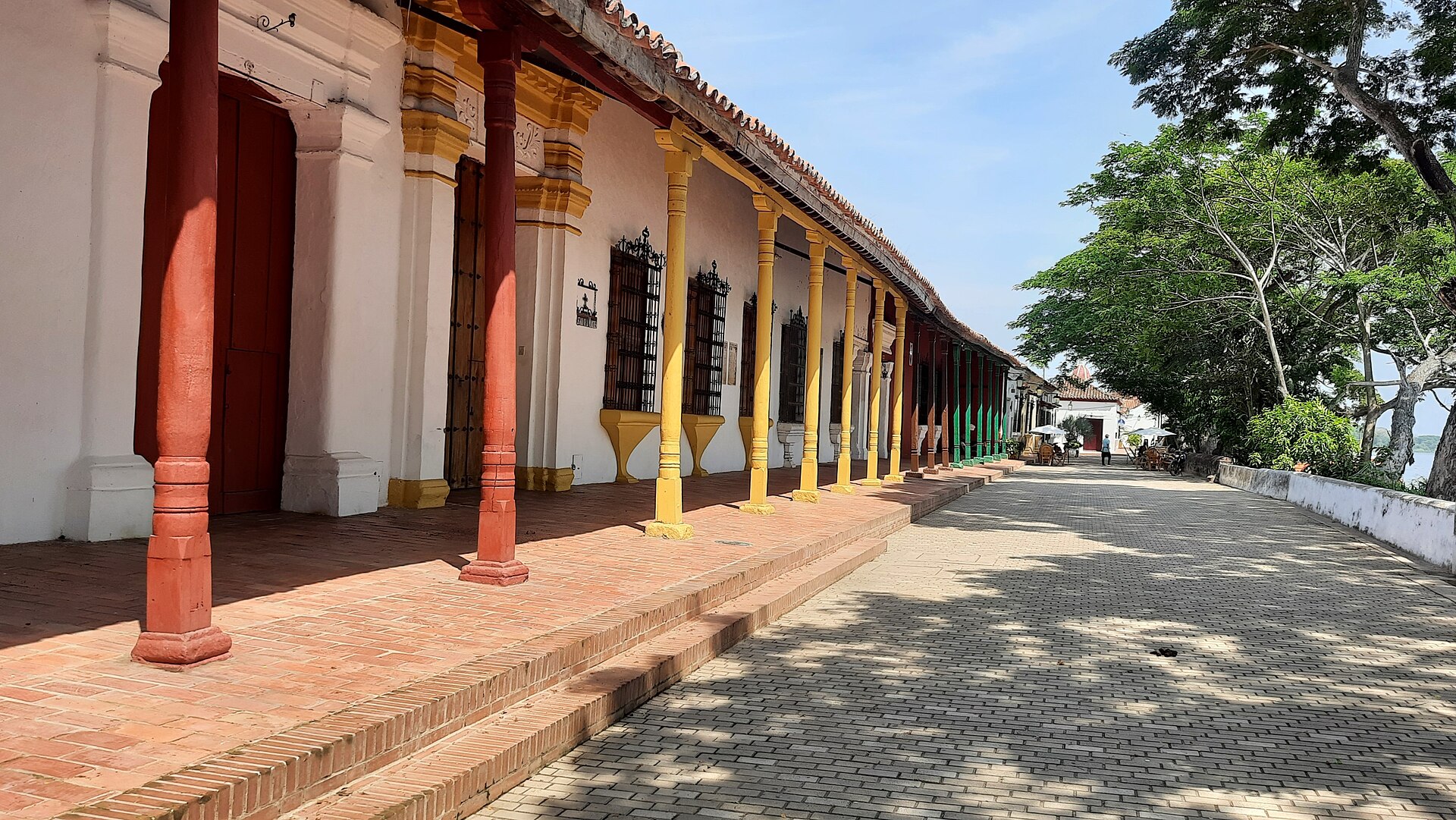
UNESCO notes that its economic decline helped preserve an unusually intact example of a Spanish colonial river settlement. The town developed lengthways beside the Magdalena rather than around the more familiar central-plaza pattern, and much of its historic fabric survived precisely because progress started passing somewhere else.
There is something wonderfully contrary about that.
Mompox became more interesting because the world temporarily stopped being interested in Mompox.
Today you get churches, shaded streets, colonial houses and the river running beside them at a pace that seems to have missed several urgent emails.
Traveller commentary repeatedly singles Mompox out as one of the memorable stops on the route, particularly for its atmosphere, historic centre and the simple pleasure of approaching it from the water.
And a river cruise solves one of Mompox’s traditional problems rather neatly.
Getting there has historically required effort.
Arriving by river turns the inconvenience into the point.
This is where river cruising becomes interesting
European river cruises are often about arriving directly into famous cities.
The Magdalena works differently.
The attraction is not simply that the ship transports you between headline sights. It provides access to smaller river communities and places most first-time visitors to Colombia would otherwise be unlikely to build into an itinerary.
The current AmaWaterways programme combines Mompox with smaller settlements, guided excursions, music, local food and cultural experiences. The ships themselves remain deliberately small: 30 staterooms aboard AmaMagdalena and 32 aboard AmaMelodia.
That scale matters.
A 60-passenger ship arriving somewhere feels very different from several thousand cruise passengers stepping ashore at once.
But this is also where Fernweh would apply a little scepticism.
“Cultural immersion” is an expression the travel industry enjoys almost as much as “hidden gem”.
A scheduled performance remains a scheduled performance.
A guided community visit is not the same thing as independently travelling through rural Colombia.
And a beautifully designed river ship is, by definition, a layer between you and whatever lies outside it.
So no: cruising the Magdalena does not make you an honorary Colombian by day four.
It shouldn’t pretend to.
What it can do is give you access without demanding expedition-level effort.
That is a different proposition, and probably the more honest one.
The early passenger verdict
There is an important caveat here: Magdalena cruising is still relatively new, so there simply isn’t the depth of independent traveller commentary you would find for the Rhine or Danube.
The early feedback is encouraging rather than conclusive.
Passengers repeatedly mention the intimacy of the smaller ships, the Colombian food, the shore experiences and Mompox in particular. More importantly, the experiences people remember tend to be ashore rather than aboard.
That feels significant.
Because staying on the ship would rather miss the point.
And it suggests a useful way to approach the itinerary: don’t judge a stop by whether you have heard of it before. Mompox may become the name you remember, but the smaller communities are part of the reason to be on the Magdalena in the first place.
This is one journey where the obscure stop on the itinerary may deserve more attention than the recognisable city.
And then there is the music
You cannot really talk about Colombia’s Caribbean region without eventually getting onto music.
Cumbia has deep roots on the Caribbean coast, while Barranquilla’s carnival — recognised by UNESCO as Intangible Cultural Heritage — brings together music, dance, costume and traditions shaped by the region’s African, Indigenous and European histories.
The cruise itinerary incorporates performances and carnival-themed experiences.
Again, the important thing is not to confuse performance with spontaneous local life.
But nor should we dismiss performance as somehow inauthentic simply because somebody told you what time it starts.
Music, dance and carnival traditions are part of the region.
Seeing them interpreted properly can be a useful doorway into understanding where you are.
And Barranquilla provides a fitting end point.
The Magdalena finishes its long journey there, meeting the Caribbean beside a city whose identity has been shaped by migration, commerce, port activity and carnival culture.
A European river cruise often finishes with another beautiful old city.
This one ends with drums.
Fair enough.
What the brochure photographs won’t tell you
Colombia’s Caribbean lowlands are hot.
Not “lovely warm evening, perhaps bring a cardigan” hot.
Hot and humid.
Mompox in particular is inland, low-lying and tropical. Walking tours need sensible clothing, sun protection and water, and the leisurely pace of river life becomes significantly less romantic if you decide midday is the ideal moment to prove your resistance to heat.
Mosquitoes and other insects are also part of travelling through tropical river country. Repellent belongs in the bag.
And although the ship removes much of the logistical friction, this is not a trip built around lying beside the pool for seven days.
There are guided walks, excursions, wildlife, cultural visits and repeated transitions between ship and shore.
People who dislike organised excursions on principle should think carefully.
The structure is part of what you are buying.
There is another consideration.
Colombia remains a country where UK travel advice varies significantly by region. As of September 2026, the Foreign, Commonwealth & Development Office advises against all but essential travel to certain parts of Colombia, although the principal areas on this Magdalena itinerary — Cartagena, Mompox and Barranquilla — are not among the locations identified in those warnings. Travellers should still check the latest advice immediately before travel, because conditions and boundaries can change.
The Colombia of today should not be lazily reduced to the Colombia of 30 years ago.
Nor should common sense be abandoned because a brochure has used attractive typography.
Does cruising keep Colombia at arm’s length?
A little.
That is the honest answer.
You return to an air-conditioned cabin.
Your meals are organised.
Somebody else has solved the transport.
Your day has structure.
There will be moments when an independent traveller staying in a family-run guesthouse is undoubtedly experiencing a version of Colombia closer to everyday life than you are.
But that isn’t the whole story.
Independent travel has its own blind spots. You can move freely and still understand very little.
The more useful question is whether the structure of the cruise helps you encounter places you otherwise would not have visited at all.
On the Magdalena, the answer looks increasingly like yes.
Mompox is the clearest example.
The smaller river settlements strengthen the case.
And spending several days physically following the water gives the journey a coherence that flying Cartagena–Medellín–Bogotá simply cannot provide.
The river is not merely transport between attractions.
It is the story holding them together.
Forget the Rhine? Not quite
There is nothing wrong with the Rhine.
It has castles.
Quite a lot of them, in fact.
But perhaps river cruising has been associated with Europe for so long that we have mistaken the format for the destination.
A river cruise does not have to mean arriving at another medieval square in time for coffee.
On the Magdalena it can mean following Colombia’s historical route towards the Caribbean, waking near a town whose decline accidentally preserved it, watching birdlife from smaller boats and discovering that the most memorable place on the journey might be one you’d struggle to locate on a map beforehand.
Is it the deepest possible way to experience Colombia?
No.
Is it an unusually accessible way to experience a side of Colombia many visitors miss?
Very possibly.
And perhaps that is the real appeal.
The ship gives you comfort.
The river does the interesting bit.
Fancy doing it?
The Exceptional Holiday that sent us down the Magdalena is a seven-night AmaWaterways journey through Colombia, travelling between Cartagena and Barranquilla and including Mompox and communities along the river. Current 2026 and 2027 programmes remain available on both AmaMagdalena and AmaMelodia.
It is a small-ship journey rather than a conventional ocean cruise, with the itinerary built around the Magdalena’s history, wildlife and Caribbean culture.
Elenel Getaways can check current sailings, flights and any land stays you might want to add before or after the river — particularly if you’d like more time in Cartagena or elsewhere in Colombia.
Current itineraries, inclusions and availability are subject to change.