
Travel Decisions
There Is No Such Thing as “The Maldives”. So How Do You Choose the Right Island?
Turquoise water. White sand. Palm trees. An overwater villa suspended above a lagoon. From Britain, the Maldives can look like one remarkably consistent holiday repeated across a thousand photographs. It isn’t. Choose the wrong island and you can spend a great deal of money discovering that paradise has rather more variables than you expected.

People often talk about booking “the Maldives” in much the same way they talk about booking Tenerife.
As though the difficult decision has already been made.
It hasn’t.
The Maldives is an archipelago of resort islands scattered across atolls, and once you start comparing them, the differences become enormous.
One island might have six restaurants, children on bicycles and enough activities to occupy a mildly restless teenager for a fortnight.
Another might have 40 villas, one exceptionally good reef and very little to do after dinner except look at the stars.
One can be 20 minutes from the airport by speedboat.
Another may involve a seaplane connection, its own luggage rules and a journey that effectively turns arrival into part of the holiday.
Both are “the Maldives”.
They may have almost nothing else in common.
So the first question should not really be:
Which Maldives resort is best?
It should be:
Which Maldives resort is best for you?
Because this is one destination where choosing the wrong hotel can mean choosing the wrong holiday.
Start with the thing nobody puts on Instagram: logistics
The Maldives begins at Velana International Airport.
What happens next matters more than most first-time visitors realise.
Some resort islands sit relatively close to Malé and can be reached by speedboat. Hilton Maldives Amingiri, for example, is currently around 20 minutes from the airport by boat and can be reached around the clock.
Other resorts require a seaplane.
Siyam World, in Noonu Atoll, is currently around 40–45 minutes from Malé by seaplane, with a domestic-flight-and-speedboat alternative. Its seaplane operation has daytime restrictions and published baggage allowances of 20kg checked plus 5kg hand luggage.
That is not a minor administrative detail.
Imagine arriving after an overnight flight from Britain.
At one resort, you can be in your villa perhaps an hour after clearing the airport.
At another, you may need to wait for a scheduled seaplane transfer, fly across several atolls, then continue to the island.
The seaplane journey can be spectacular.
It is also another journey.
Neither option is automatically better.
A remote atoll can provide a much stronger sense of escape. A short speedboat transfer can be enormously appealing when you are travelling with small children, arriving late, or simply have no desire to turn a ten-hour flight into a 16-hour door-to-pillow operation.
This is the first Maldives decision people often overlook:
How remote do you actually want paradise to be?
Small island does not automatically mean better island
There is a romantic idea of the Maldives involving an island so tiny you can walk around it before breakfast.
For some people, that is exactly the point.
For others, it becomes slightly alarming around day four.
Island size changes almost everything.
Smaller resorts can feel intimate. Fewer villas may mean fewer people, quieter beaches and a stronger sense that you have disappeared from the world.
But small can also mean fewer restaurants, fewer facilities and fewer places to go when you discover that you don't actually want to eat in the same dining room for the seventh consecutive evening.
Large resorts solve that problem rather emphatically.
Siyam World, for example, is one of the Maldives' largest resorts, with 470 accommodation units and a formidable range of dining, sports and entertainment facilities. Its current restaurant collection ranges across Maldivian, Thai, Indian, Spanish and Japanese food, among others.
It also has family accommodation, a kids' club, a floating waterpark, sports facilities and enough activity that it would be difficult to confuse the place with a Robinson Crusoe fantasy.
For some travellers, that sounds ideal.
For others, it sounds suspiciously like the thing they flew 5,000 miles to escape.
Neither reaction is wrong.
The point is that resort scale is part of the atmosphere.
Do not choose a large island because it offers “more”.
Do not choose a small island because it sounds “exclusive”.
Choose the one whose amount of life matches yours.
The house reef may matter more than the room
This is where experienced Maldives travellers become mildly evangelical.
First-time visitors often begin with the villa.
Repeat visitors frequently begin with the reef.
A house reef is the coral reef accessible directly from the resort island rather than requiring a boat excursion.
If snorkelling is central to your idea of the Maldives, this can completely change the holiday.
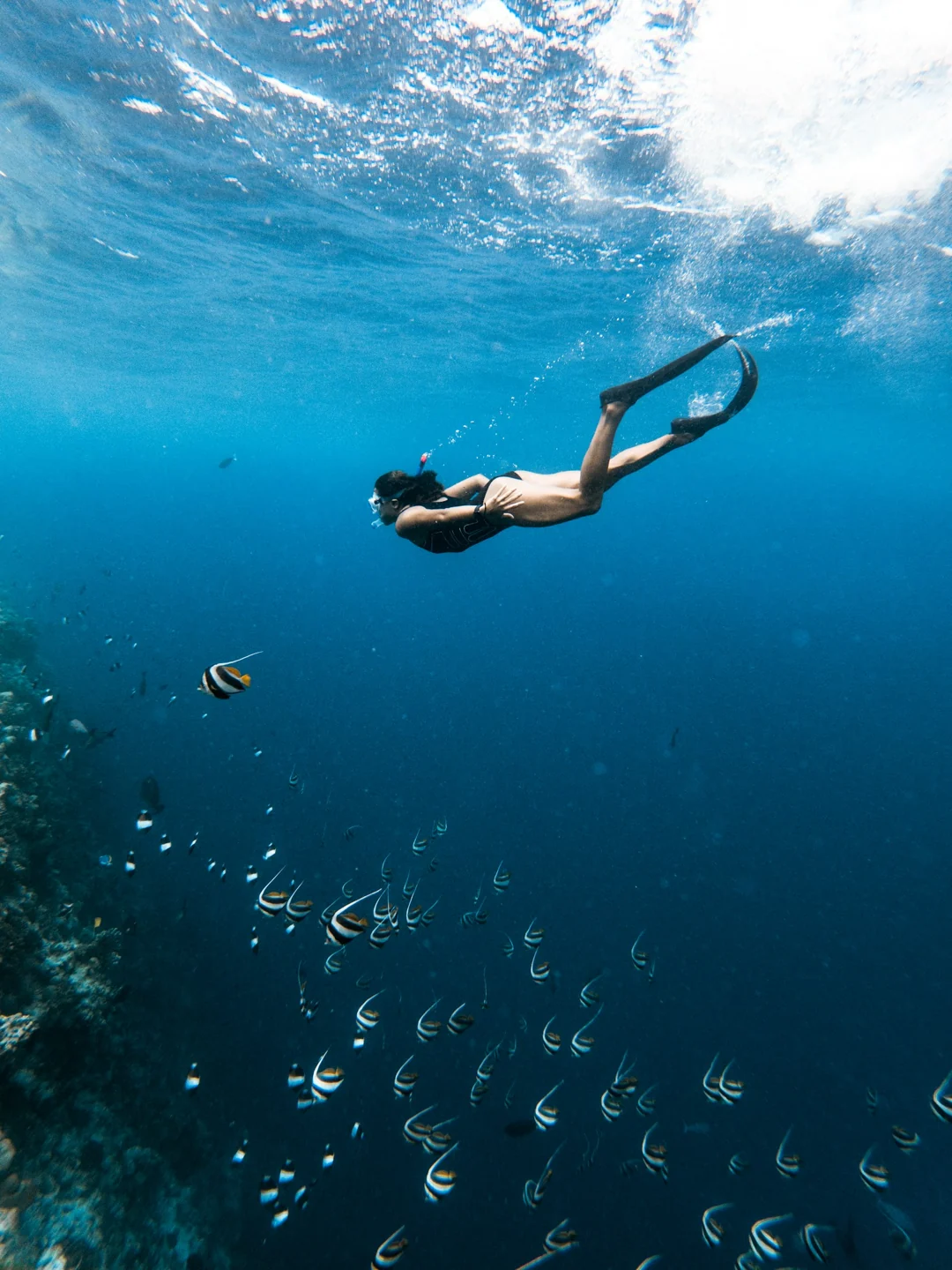
At the right resort, you can walk off the beach or descend from a jetty and be among reef fish, rays, turtles or reef sharks within minutes.
At another, the lagoon may be beautiful for swimming but have little interesting snorkelling immediately offshore.
You can still take boat trips.
But that is a different experience from deciding at 9.17 on Tuesday morning that you fancy half an hour with the fish before breakfast settles.
Traveller discussions on Tripadvisor repeatedly show house-reef quality sitting remarkably high on the list of priorities for experienced visitors — often above villa type. Families also frequently distinguish between a spectacular reef and an accessible one: strong swimmers may enjoy a reef edge that is entirely unsuitable for a nervous eight-year-old.
That distinction matters.
“Excellent snorkelling” and “easy snorkelling” are not necessarily the same thing.
Ask where the reef is.
Ask how you reach it.
Ask about currents.
Ask whether there are easy entry points.
And if marine life is one of the main reasons you are going, do this before becoming emotionally attached to a photograph of the bathroom.
About that overwater villa
The overwater villa may be the most successful piece of travel marketing ever invented.
There it is.
Deck.
Lagoon.
Stairs into the sea.
Breakfast tray floating somewhere it was never really designed to float.
For many travellers, staying over water genuinely is part of the dream.
But it is not automatically the best room on the island.
A beach villa can give you your own piece of sand, shade from mature vegetation, more privacy from passing boats and the simple pleasure of walking barefoot from bed to sea without first crossing 200 metres of jetty in midday heat.
It can also be significantly better for families with young children.
An overwater villa gives you uninterrupted views and direct sea access, but the water beneath it may be deep, tidal or unsuitable for less confident swimmers. Some resorts restrict younger children in certain water-villa categories or require parental waivers.
There is also the apparently trivial matter of walking.
Some overwater jetties are long.
Very long.
The sunset is delightful.
The fourth forgotten pair of sunglasses is less so.
And weather matters. When the wind gets up and the sea is restless, a villa perched over the water feels rather more connected to the Indian Ocean than the brochure may have implied.
So no, a beach villa is not the consolation prize.
Sometimes it is the better room.
And a private pool is not automatically an upgrade either
This one sounds almost heretical.
If you are surrounded by one of the clearest lagoons on Earth, why exactly do you need a chlorinated rectangle beside it?
There are good answers.
Privacy.
Small children.
Somewhere to cool off without walking anywhere.
A pool can transform a villa if the sea immediately outside is not ideal for swimming. It can also be useful during rougher conditions or simply because sometimes you want to lie in water without sharing it with marine biology.
At resorts such as Hilton Maldives Amingiri, both beach and overwater villas currently include private pools, so the decision becomes more about setting than about “upgrading” to one.
But a private pool consumes space and usually money.
If you would choose the sea every time, do not pay thousands extra merely because somebody decided a Maldives villa ought to have one.
More expensive is not the same as more suitable.
That may be the single most useful sentence in this article.
What are you actually going to eat for seven nights?
Food is another subject people underestimate while concentrating on the view.
On most Maldives resort islands, you cannot stroll into town because there isn't one.
You are eating at the resort.
Every day.
Possibly for ten days.
Suddenly the difference between two restaurants and eight becomes quite important.
Hilton Maldives Amingiri currently has eight restaurants and lounges. Siyam World operates a much larger collection of dining venues covering a broad range of cuisines.
Again, more isn't automatically better.
A small resort with three superb restaurants might suit you far better than a huge island with endless choice.
But variety becomes more important the longer you stay.
So does the meal plan.
Breakfast-only can appear attractively priced until you discover what dinner costs when the next restaurant is on another island.
Half-board gives certainty while preserving some freedom.
Full-board makes sense for people who expect to eat three proper meals a day.
All-inclusive can be excellent value, particularly at resorts where drinks, à la carte restaurants, activities and water sports are genuinely included.
Or it can be a very expensive way of pre-paying for things you never use.
Read the inclusions.
“Premium all-inclusive” is not a regulated scientific term.
At one resort it might include several à la carte restaurants, cocktails, minibar and excursions.
At another, it may mainly mean buffet meals and house drinks.
The words are less useful than the small print.
Family-friendly and peaceful are not opposites — but they need managing
The Maldives once had a reputation as a destination designed almost entirely for honeymooners.
That version still exists.
So does a very different Maldives.
Some islands now have enormous kids' clubs, family pools, football, padel, waterparks, multi-bedroom villas and enough organised activity to leave parents wondering whether their children have quietly joined another family.
Siyam World is firmly in that camp, with extensive family accommodation and activities alongside adult-focused areas.
Hilton Amingiri likewise combines family facilities, a kids' club and sports with private-pool villas and adult spaces.
That does not make either resort noisy.
But it does illustrate something worth asking:
Who was this island designed for?
There is a difference between a resort that accepts children and one designed around families.
There is also a difference between an adults-only resort and somewhere simply quiet enough that you rarely notice anybody else.
Couples should not assume “family-friendly” means unsuitable.
Families should not assume “luxury” means their children will be tolerated rather than welcomed.
The layout matters.
Where is the kids' club?
Where are the family villas?
Are there adults-only pools or restaurants?
How far is your villa from the evening entertainment?
These are rather more useful questions than whether the resort describes itself as “serene”.
They all do.
Being confined to an island is either the point or the problem
This is perhaps the most important Maldives question of all.
You are not going somewhere in the conventional sense.
You are going to a resort.
On many trips, the hotel is a base.
In the Maldives, the hotel is the destination.
There is no wandering through a different neighbourhood after dinner.
No finding a restaurant down a side street.
No deciding to hire a car tomorrow and see what is over the hill.
Unless your itinerary includes local islands, excursions or a split stay, you will spend the holiday in one contained world.
Some people find that blissful.
Breakfast.
Swim.
Read.
Snorkel.
Lunch.
Nap.
Repeat until Britain becomes a distant administrative problem.
Other people are twitching by the third afternoon.
Neither type of traveller should attempt to become the other.
If you need novelty, choose an island with more restaurants, activities, excursions and physical space — or consider splitting the holiday between two resorts.
If the entire purpose is to stop deciding things, a smaller island with one beautiful beach and a good reef may be exactly right.
The trick is knowing which person you are before paying the deposit.
Perhaps the Maldives is not a destination at all
That sounds ridiculous.
Geographically, obviously it is.
But from a traveller's point of view, “the Maldives” is almost too broad to be useful.
A week on a tiny reef-focused island with 40 villas is not the same holiday as a week at a sprawling family resort.
An overwater villa 20 minutes from Malé is not the same proposition as a beach villa reached after a seaplane journey deep into another atoll.
A resort chosen for manta excursions is not the same as one chosen because your four-year-old requires a kids' club, a shallow lagoon and pasta on demand.
The water may be the same implausible colour.
That is about where the similarity ends.
So when somebody asks us which Maldives island is best, the answer should probably be another question.
What do you want to do when you get there?
Snorkel every morning?
Disappear as a couple?
Keep children occupied?
Eat somewhere different every night?
Walk around the entire island in ten minutes?
Have enough going on that ten nights never feels long?
Or do almost nothing whatsoever?
Because the expensive mistake is not choosing a bad Maldives resort.
There are plenty of very good ones.
It is choosing an excellent resort designed for somebody else's holiday.
Fancy doing it?
Two current Elenel Exceptional Holidays illustrate the point rather neatly.
Siyam World Maldives is a large Noonu Atoll resort built around choice: extensive dining, activities, family facilities, multiple accommodation types and a seaplane arrival.
Hilton Maldives Amingiri Resort & Spa offers a different version of the destination, with private-pool beach and overwater villas, eight restaurants and lounges, and a 20-minute speedboat transfer from Velana International Airport.
Neither is “the better Maldives”.
That is rather the point.
Elenel Getaways can compare the current options and help narrow the islands down according to what actually matters to you — reef, transfer, food, family facilities, privacy, villa type or simply how much you intend to do once you arrive.
Current resort facilities, transfers, inclusions and availability are subject to change.