
Islands & Journeys
The Greek Islands You Can’t Fly To — and Why That Might Be Their Best Feature
No runway. No direct flight. Sometimes not even a particularly convenient ferry. Yet some of Greece’s most rewarding islands may have kept their character precisely because getting there requires one more step.
Modern travel is obsessed with removing friction.
Direct flights. Short transfers. Fast-track security. Hand luggage only. Ideally, you land before lunch and are by the pool before anyone has had time to argue about who packed the sun cream.
Then there are islands such as Symi, Skopelos, Paxos, Halki and Tinos.
No airport.
No direct arrival.
You get off the plane somewhere else, make your way to a port, check the ferry board, drag your case towards the right vessel and wait for the island to appear over the horizon.
It is slower.
It is less convenient.
And that may be part of the attraction.
Not because inconvenience is inherently romantic. Sometimes a missed connection is just a missed connection.
But because access shapes places.
An island without an airport does not automatically become quiet, authentic or untouched. Plenty of ferry-only islands are busy in high season, and day-trippers can arrive in serious numbers.
What the absence of a runway does create is a small amount of friction.
And sometimes that is enough to change the rhythm.
The ferry is part of the holiday — until it isn’t
There is something a flight cannot reproduce about arriving at an island from the sea.
The harbour appears gradually.
Church towers become visible.
Houses begin separating themselves from the hillside.
Someone starts moving suspiciously early towards the luggage deck.
By the time the ferry doors open, you already feel as though you have travelled somewhere.
That is the romantic version.
The less romantic version involves timetables.
Ferries can be delayed or cancelled by weather. Seasonal schedules change. A delayed inbound flight can leave an onward connection looking considerably less clever than it did when you booked it. Traveller discussions around Skopelos, Paxos and Halki repeatedly return to the same issue: allow enough margin, particularly when connecting back to a flight, and never assume a summer ferry schedule will operate unchanged at the edges of the season.
So the argument here is not that ferries are better than airports.
It is that some islands are worth the extra step.
And these five make the case rather well.
Symi: arrive by sea or miss half the point
There may be no better introduction to this idea than Symi.
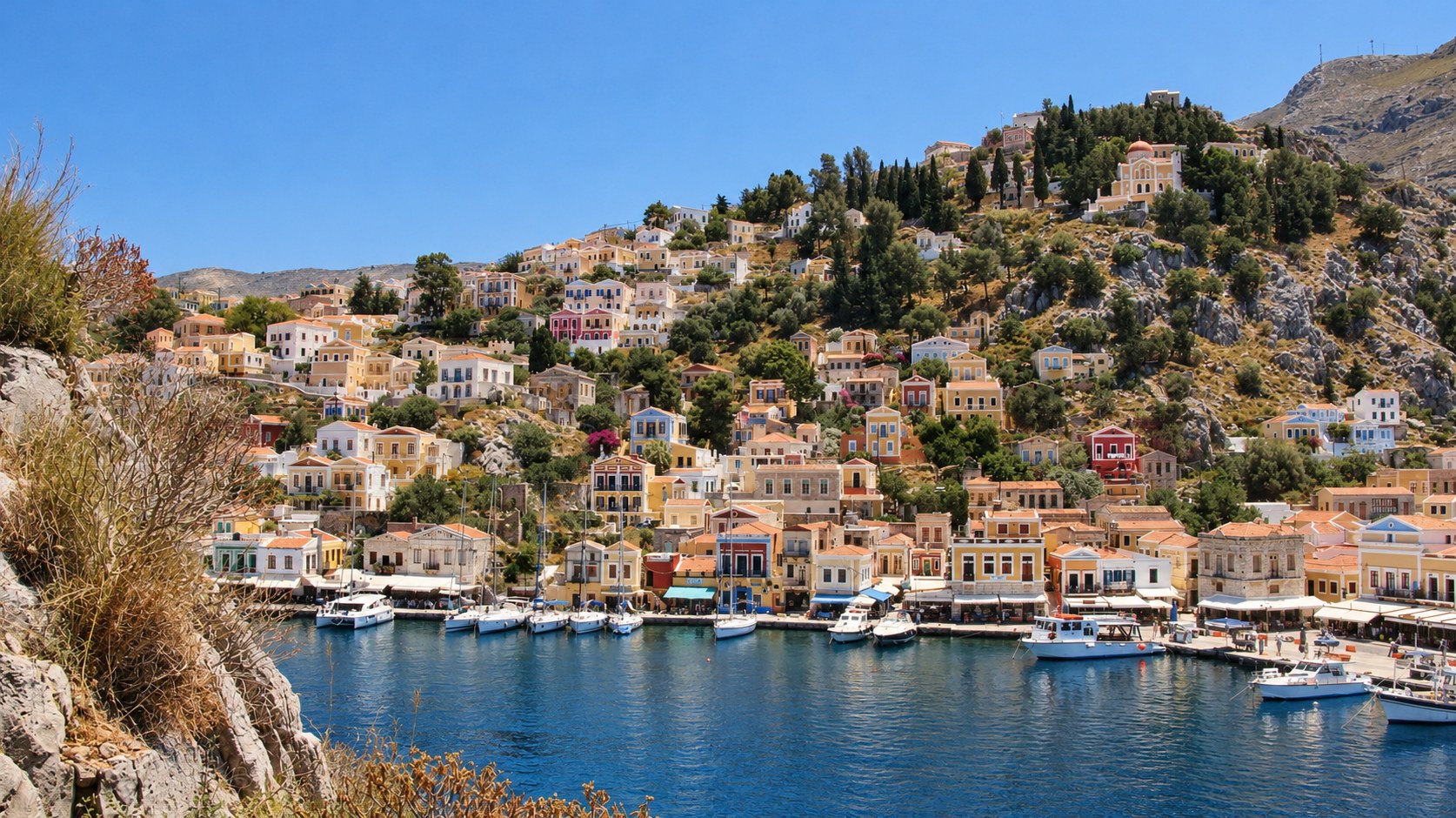
Official Greek tourism guidance describes the arrival into Symi harbour as part of the experience itself: neoclassical houses in warm colours climb amphitheatrically above the water, a legacy of the island’s history in sponge diving, shipbuilding and wood carving. The usual route is via Rhodes, followed by ferry.
That means the first view matters.
You do not emerge from baggage reclaim beside a taxi rank.
You sail into Gialos.
And Symi is one of those places where arriving by sea feels less like transport and more like theatre.
The danger is seeing only that.
Day trips from Rhodes are popular, and Gialos can become considerably busier while excursion boats are in port. The more interesting question is what happens if you stay.
This is where Symi changes.
The harbour softens in the evening.
Pedi offers a quieter base on the other side of the ridge.
Water taxis open up beaches and coves that make more sense from the sea than from a road map.
Traveller discussions repeatedly distinguish between seeing Symi as a day trip and actually staying there, with the latter giving a much calmer impression once the daytime traffic has gone.
That may be the first useful lesson of ferry-only Greece:
sometimes staying overnight is the difference between visiting an island and actually experiencing it.
Skopelos: Mamma Mia got people there. The island has to do the rest.
Skopelos comes with baggage.
Not luggage.
ABBA.
The island became internationally famous after scenes from Mamma Mia! were filmed there, most obviously around the chapel of Agios Ioannis at Kastri.
It would be silly to pretend that does not matter.
It would be equally silly to reduce Skopelos to a film location.
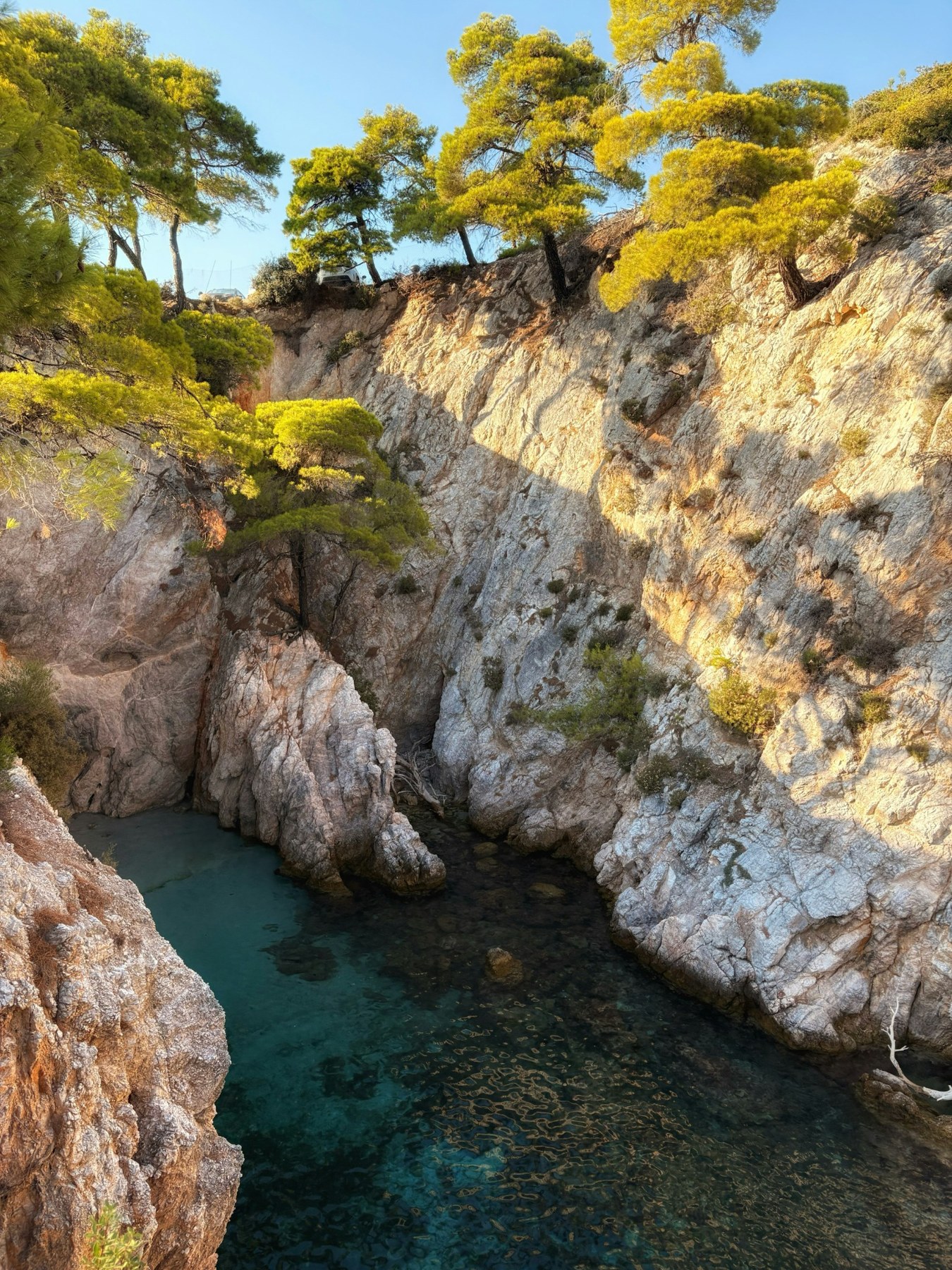
The Greek National Tourism Organisation describes it as the largest island in the Northern Sporades, heavily wooded, with pine forests running towards the sea, traditional settlements and beaches where the landscape feels very different from the stereotypical bare-white-and-blue image of the Cyclades. Access commonly runs through Skiathos and then ferry.
That greenery is the real surprise.
Skopelos does not look like the Greece many first-time visitors have in their head.
It is softer.
More wooded.
More folded into the landscape.
And that gives the island an identity that exists quite happily without Pierce Brosnan singing.
The practical catch is that the ferry matters.
Recent traveller reports describe weather disruption, altered arrival ports and limited sailings outside peak season. One visitor reported a cancellation and a diversion to Agnontas rather than the expected Skopelos or Glossa port.
That does not make Skopelos difficult.
It makes it somewhere you should plan sensibly.
The ferry connection should have breathing space, particularly before a flight home.
Because “slow travel” loses some of its charm when you are refreshing an airline app in a harbour.
Paxos: how small is too small?
Paxos makes a different case.
It is not really about dramatic arrival.
It is about scale.
The island lies south of Corfu and is reached by ferry, with official tourism information giving a typical fast-ferry journey of around 55 minutes from Corfu to Gaios. Gaios itself is a compact harbour town facing small wooded islets, while the island is covered in olive groves, coves and small settlements.
It is beautiful.
It is also small.
That distinction matters.
People often say they want “quiet”.
What they sometimes mean is “quiet, but with twelve restaurants, three cocktail bars, enough shopping for an afternoon and something different to do tomorrow”.
Paxos asks whether they really mean it.
Gaios, Loggos and Lakka provide enough life to prevent the island feeling abandoned, and regular visitors describe the evenings as lively enough precisely because people gather into a small number of places.
Then there is the water.
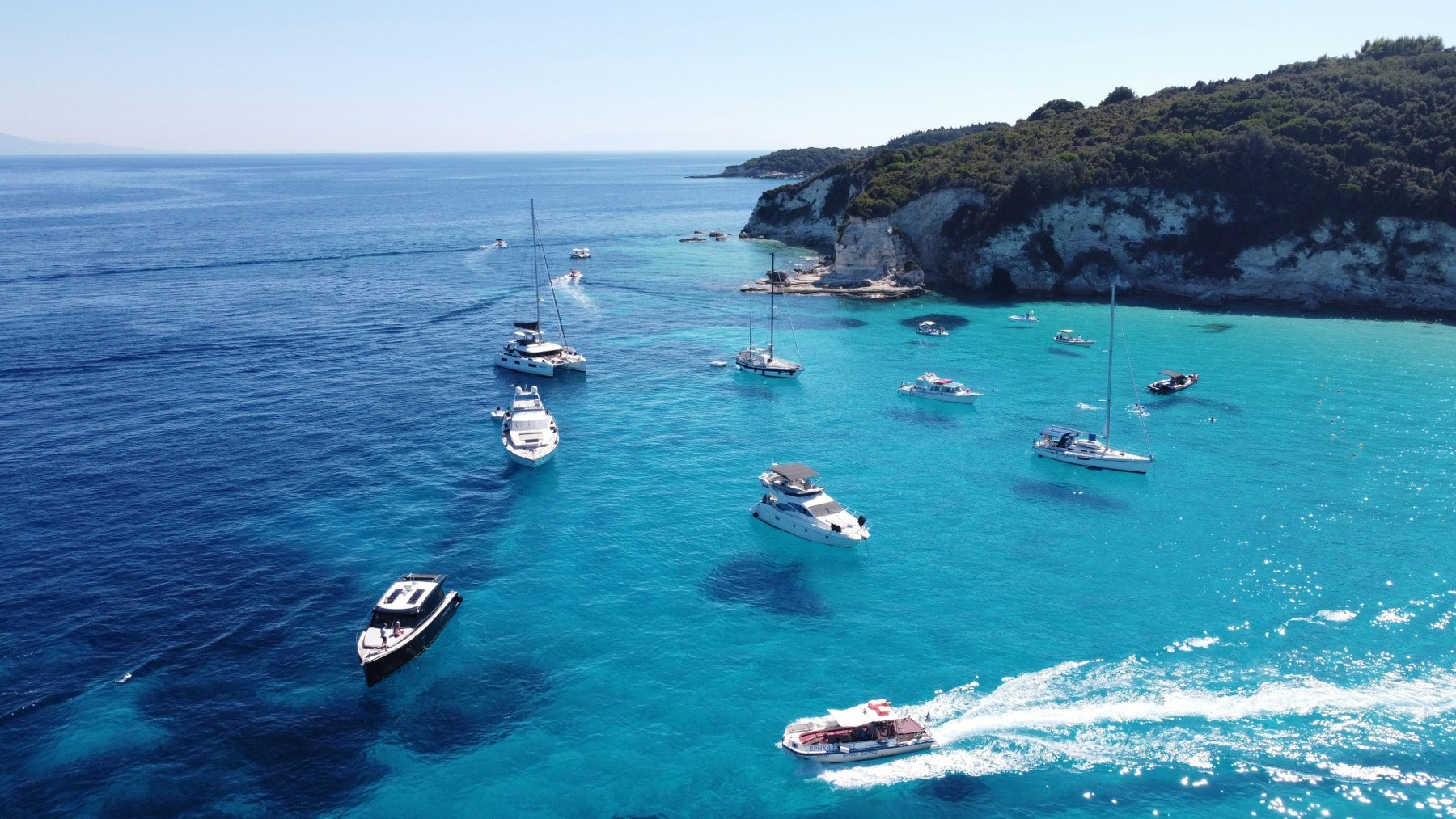
Much of Paxos makes most sense by boat. The island’s coast is broken into small coves, caves and pebble beaches, and the official tourism authority actively recommends hiring a small boat or taking a sea trip to explore them. Nearby Antipaxos is an obvious addition, although its beaches become much busier in July and August.
So is Paxos too quiet for a week?
For some people, absolutely.
If you need monuments, nightlife and a new attraction every morning, it may begin testing you by Wednesday.
If your idea of a successful afternoon is a swim, a boat and a lunch that accidentally becomes dinner, you may wonder why anybody built an airport anywhere.
Halki: what happens when almost nothing happens?
Halki — also written Chalki — takes the idea further.
The island sits west of Rhodes and is reached by ferry. Greece’s official tourism site describes Nimborio as the island’s only settlement, wrapped around a natural harbour of neoclassical houses, with beaches and walking routes spreading out from it.
There is not a great deal going on.
That is not criticism.
It is the product.
Traveller discussions repeatedly describe Halki as quieter than Symi, with beaches such as Ftenagia and Pondamos reachable on foot and Kania accessible on foot or by seasonal water taxi.
And this is where travellers need to be honest with themselves.
Halki could be glorious for three or four nights.
It could also feel far too small for somebody expecting a conventional two-week resort holiday.
The question is not whether Halki has “enough to do”.
That is the wrong measure.
The better question is whether you are comfortable with a holiday where the day may revolve around a swim, lunch, another swim, a walk back to the harbour and deciding where to eat.
There is a Fernweh line hiding in that:
Halki’s attraction is not that there is an enormous amount to do. It is that eventually you stop wondering what you’re supposed to be doing.
For the right traveller, that is a feature.
For the wrong one, it is a warning.
Tinos: the Cyclades without pretending Mykonos doesn’t exist
Tinos offers the smartest contrast of the five.
You can fly into Mykonos.
Then leave it.
Official tourism guidance puts the ferry from Mykonos to Tinos at roughly 15–30 minutes, depending on service.
That short crossing moves you into a different version of the Cyclades.
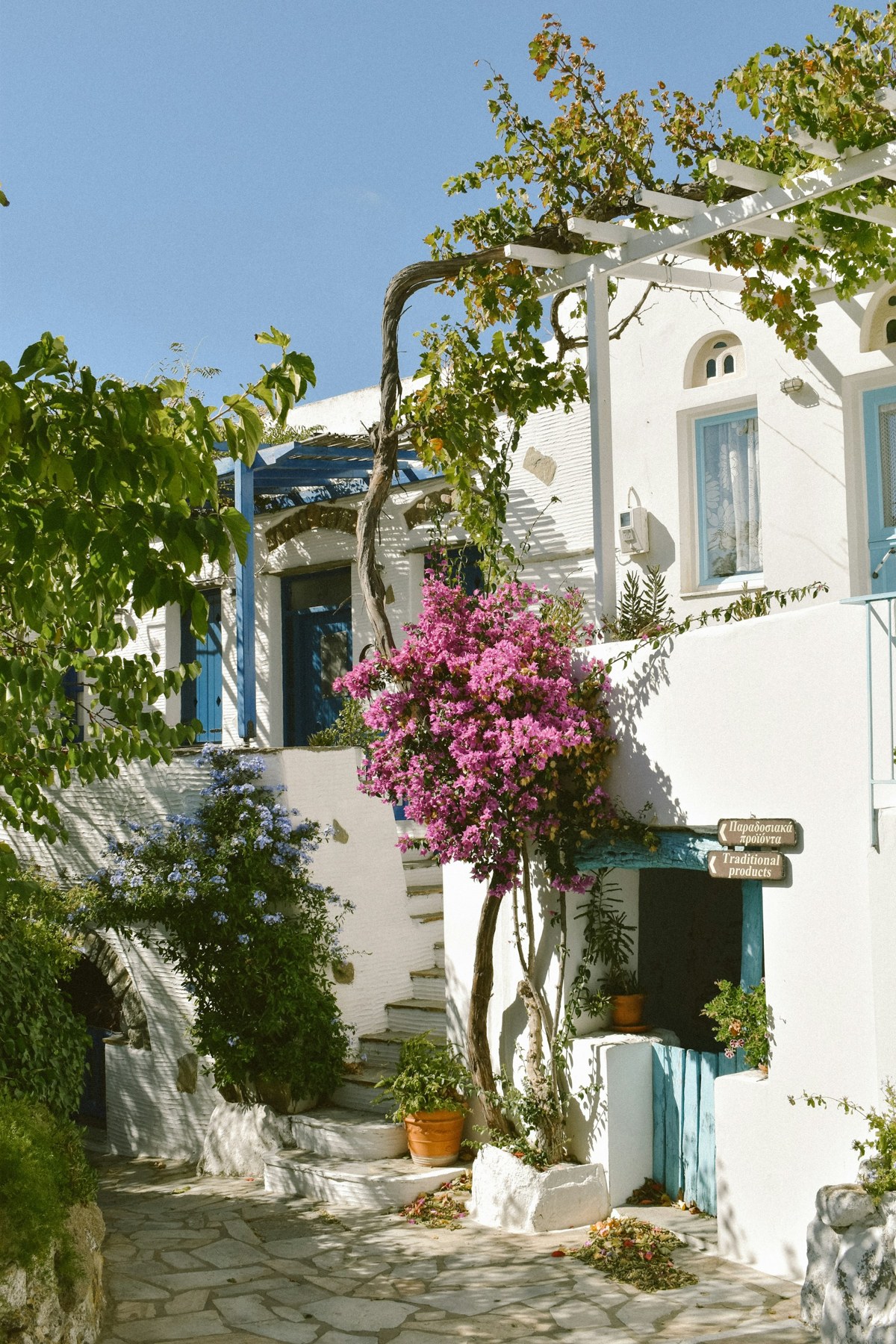
Tinos is one of Greece’s most important Orthodox pilgrimage destinations, but the island is also known for marble craftsmanship, traditional villages, dovecotes, food and a mountainous interior shaped by terraces and footpaths. The Greek tourism authority identifies around 40 traditional villages and more than 600 dovecotes across the island.
This is not simply “quiet Mykonos”.
That would undersell both islands.
The more interesting trip may be to combine them.
A few nights somewhere highly polished and outward-facing.
Then a ferry.
Then Tinos.
Pyrgos.
Villages.
Food.
A different pace.
Traveller discussions often focus less on beaches than on whether visitors can explore Tinos’s scenery and villages without a car — which tells you something about why people are going there in the first place.
Perhaps that is the cleverest way to use ferry-only access.
Not to pretend the famous island is inferior.
But to let the contrast improve both.
Does having no airport really protect an island?
Not necessarily.
This is where we should challenge our own premise.
An island can have no airport and still be crowded.
Symi can receive large numbers of day visitors from Rhodes.
Antipaxos becomes notably busier in July and August.
Tinos can be intensely busy around major religious dates.
Skopelos’s film fame did not remain a secret.
The absence of an airport is not a conservation policy.
It does not guarantee authenticity.
It does not prevent overdevelopment.
And it certainly does not make somewhere “undiscovered”, which is one of those travel words that generally means other people have been going there for decades but the writer has only just noticed.
What no airport does create is friction.
You have to choose the island.
Commit to the transfer.
Build the ferry into the holiday.
Sometimes stay long enough to justify getting there.
That changes behaviour.
And even when it does not protect the island from popularity, it can change how people encounter it.
Slow travel should not mean constant travel
This is the trap.
Someone discovers island-hopping and suddenly plans:
Rhodes.
Symi.
Halki.
Ferry.
Another ferry.
Three nights somewhere.
Two nights somewhere else.
Back to Rhodes.
Flight.
Laundry.
Recovery.
That is not necessarily slow travel.
It is a complicated multi-centre holiday conducted partly at sea.
The better principle is:
Slow travel should mean travelling less, not merely travelling slowly between too many places.
One ferry-only island may be enough.
Two can work beautifully if the geography makes sense.
Five in one fortnight starts to resemble an administrative challenge.
The clever version is probably pairing an airport island with one place that requires the extra step:
Rhodes + Symi.
Rhodes + Halki.
Skiathos + Skopelos.
Corfu + Paxos.
Mykonos + Tinos.
You retain straightforward access to Greece while gaining somewhere that feels meaningfully different.
And because ferry schedules change seasonally and weather can affect operations, the final night before an early flight sometimes belongs back on the airport island rather than on the romantic one.
That is not defeat.
It is good planning.
So which one is for you?
Symi if you want architecture, harbour life and an arrival you will remember.
Skopelos if you want green landscapes, beaches and proof that there is considerably more to the island than Mamma Mia!.
Paxos if waterfront meals, boats, coves and doing very little sound suspiciously like a plan.
Halki if you genuinely want to switch off rather than merely saying you do.
Tinos if food, villages, culture and another side of the Cyclades appeal more than spending the entire week horizontal beside the sea.
None is automatically better than an island with an airport.
That is not the point.
They simply ask more of the journey.
And in return, they sometimes give the arrival more meaning.
Perhaps inconvenience has been useful after all
Airports are extraordinarily useful.
Nobody needs to spend a holiday pretending otherwise.
But there is something about standing on the deck of a ferry while an island slowly takes shape ahead of you that an arrivals hall will never quite reproduce.
Symi, Skopelos, Paxos, Halki and Tinos have not retained their character because nobody discovered them.
People discovered them years ago.
Perhaps they have simply remained inconvenient enough that getting there still feels like going somewhere.
Fancy doing it?
This story was inspired by Greek island-hopping holidays that combine UK flights with ferry-only islands such as Symi, Skopelos, Paxos, Halki and Tinos.
Elenel Getaways can build the journey around the island rather than expecting you to work backwards from a ferry timetable — including flights, accommodation, transfers and the ferry connections in between.
And if the best version turns out to be one airport island plus one slower one, that is probably preferable to collecting ferry tickets for sport.
Ferry routes and seasonal timetables change, and services can be affected by weather. Current connections should always be checked for the specific travel dates before booking.